

Impact as a strategic lever, not just a showcase: OpenClassrooms publishes its 2026 Mission Report
Every year, OpenClassrooms publishes its Mission Report to review its social and environmental impact. This year, we present the results of the 2026 edition (covering the year 2025) through the eyes of those who make education a powerful lever for success every day.
Making Education Accessible to Everyone
In 2018, OpenClassrooms became a pioneer by adopting the legal status of a mission-driven company with a clear objective: "To make education accessible." It is this calling, anchored in Article 2 of our articles of association, that guides all our decisions and actions.
Jean-Philippe Courtois, Chairman of the OpenClassrooms Mission Committee, looks back at why he is committed to our mission.
“Students, mentors, employers, partners, investors: all those whose voices are heard around this table. It is this diversity that keeps our standards so high. It is also what carries us forward. Because our mission is not simply decreed from on high. It is built, student by student, day by day.”
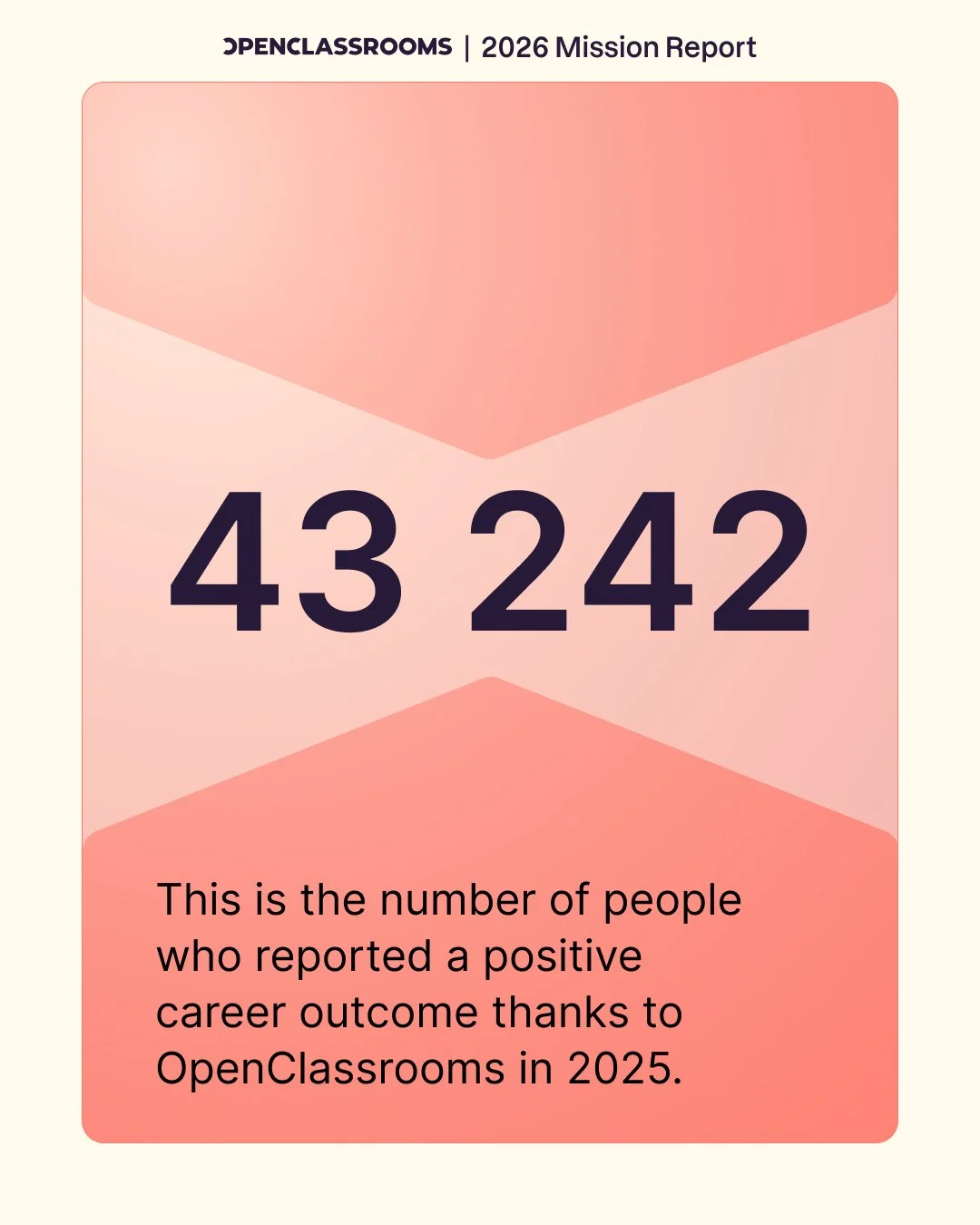
Our 2026 Mission Report details this commitment with complete transparency. Beyond the figures, our greatest pride is measured in transformed lives: in 2025, just like in 2024, 43,242 people reported positive career outcomes following their training with OpenClassrooms (finding a job, securing an apprenticeship, earning a promotion, or starting their own business). This is the key metric by which we measure the success of our mission.
“There’s something a little overwhelming about taking stock, year on year, of what we’ve achieved with OpenClassrooms. Not because we’re vain, but rather because it forces us to consider our reason to be and ask: where are we with our mission? Have we stayed the course and succeeded in making education more accessible?”
Pierre Dubuc, CEO and co-founder of OpenClassrooms, explains why we produce a mission report every year.
While the full OpenClassrooms 2026 Mission Report can be read in its entirety, we have selected the main takeaways below:
A - Breaking down social and economic barriers
We firmly believe that potential should never be held back by background or financial means. In 2025, access for underrepresented groups significantly accelerated:
Low qualification levels: the share of admitted students with a low level of education (high school diploma maximum) climbed to 35% in 2025, compared to 27% the previous year.
Priority Neighborhoods (QPV): they account for 8% of our admitted students in 2025.
“Access to education has to start with admissions. The OpenClassrooms vision is that quality education should be provided not through strict admission criteria, but through effective teaching and support to help the greatest number succeed.”
Charlène Friang, Chief Education Officer at OpenClassrooms, explains what "making education accessible" truly means.
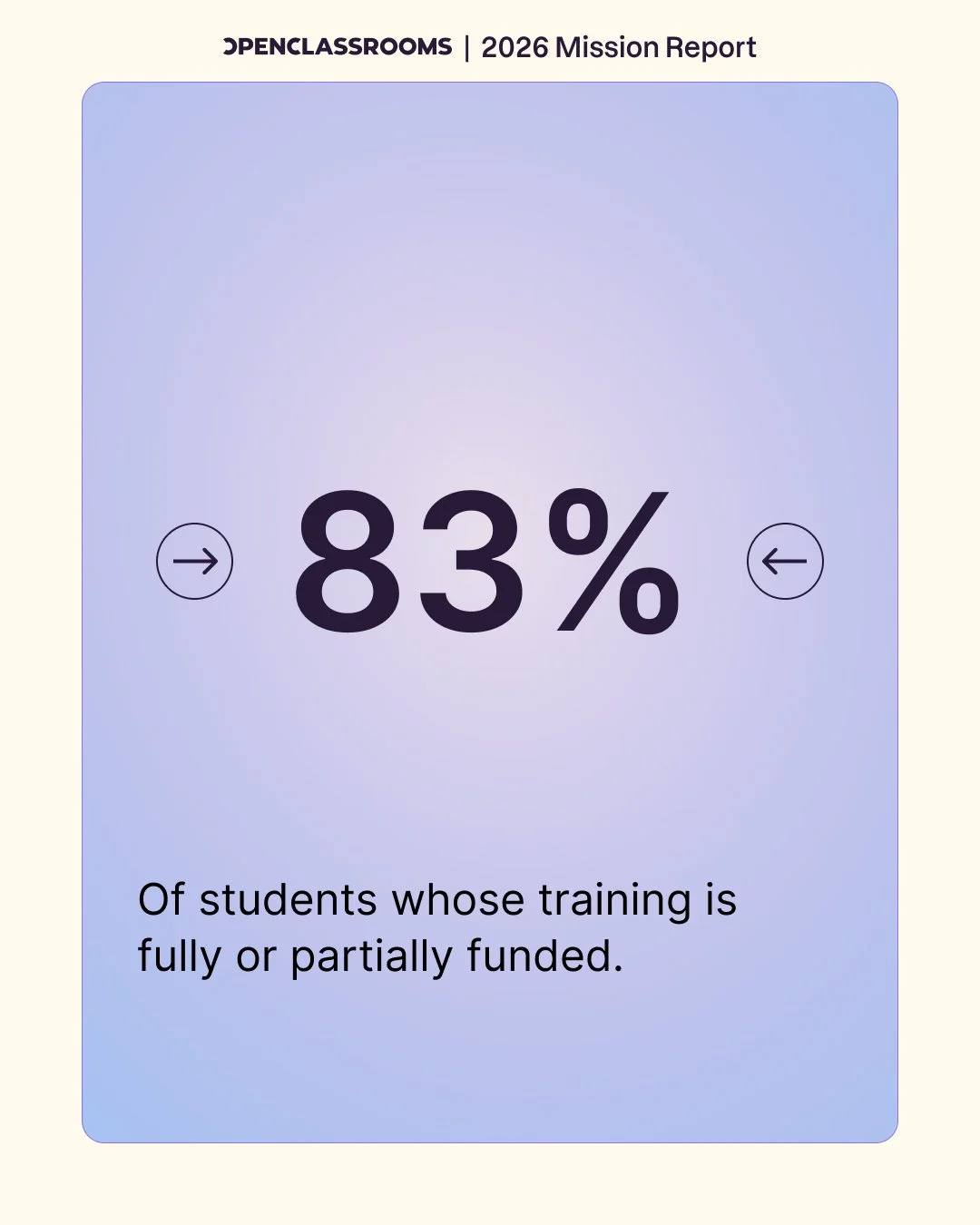
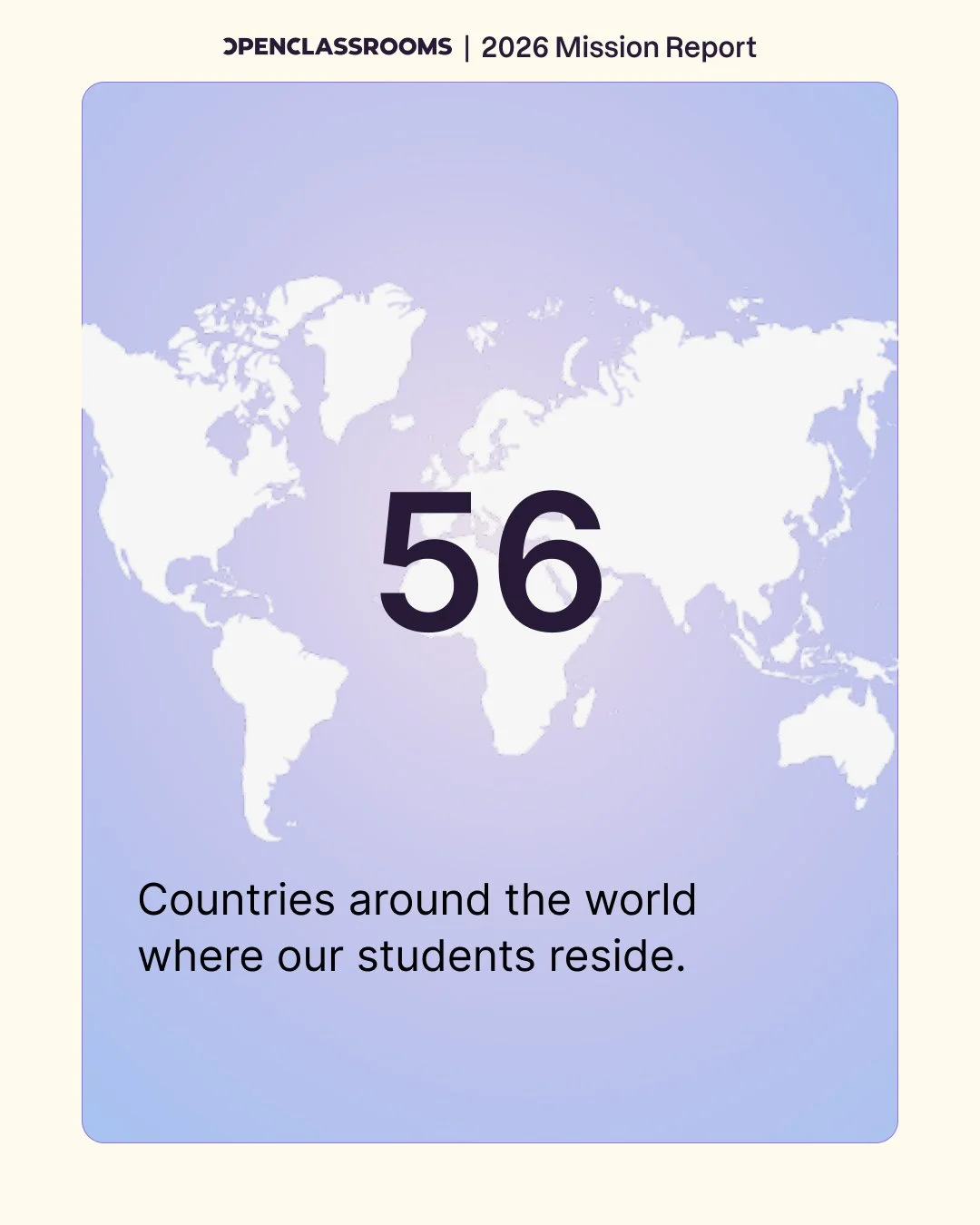
To achieve this, financial accessibility is key: 83% of students benefit from tuition funding thanks to solutions we develop with our partners. Furthermore, the application process has been simplified: 66% of applicants receive an immediate answer regarding their eligibility and funding options.
B - Accessible learning: the milestone for disabilities
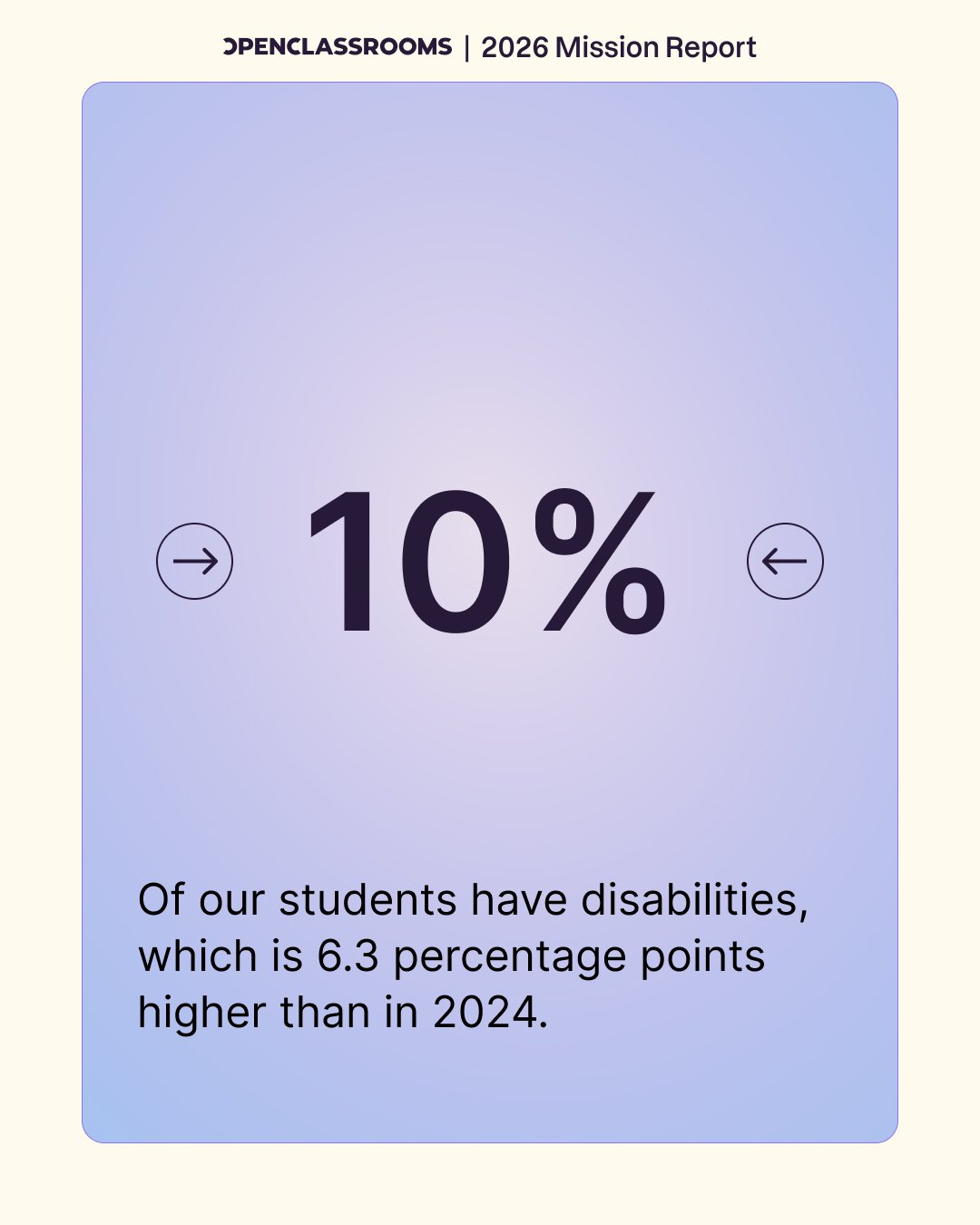
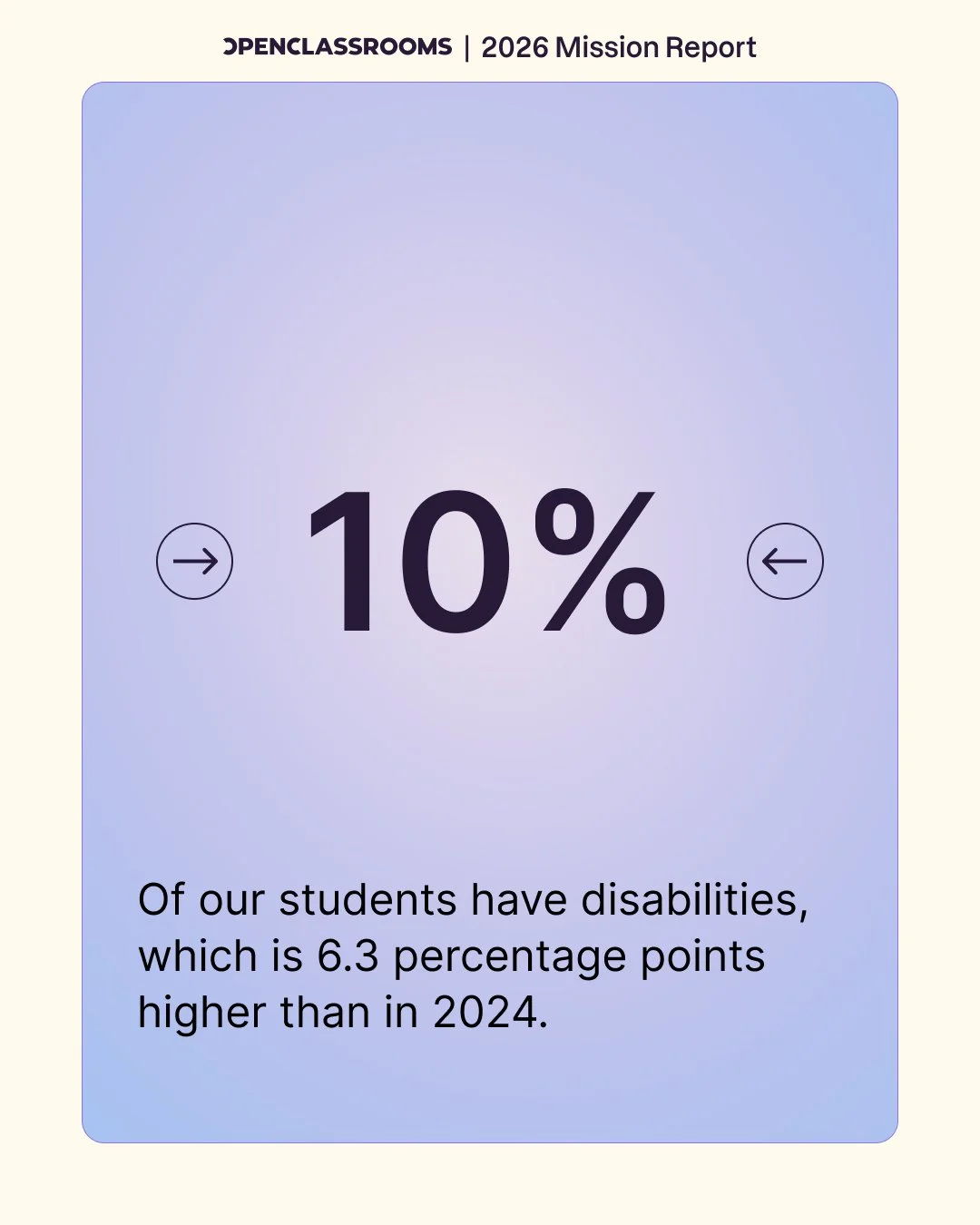
Accessibility also means adapting our programs to individual needs. The year 2025 marked a historic milestone: the share of students with disabilities among our student body jumped from 4% to 10% in a single year. Their overall admission rate stands at 80%, aligning perfectly with the university general average.
To support this momentum, concrete actions are being taken on the ground:
10% of our mentors are specifically trained to support students declared with disabilities.
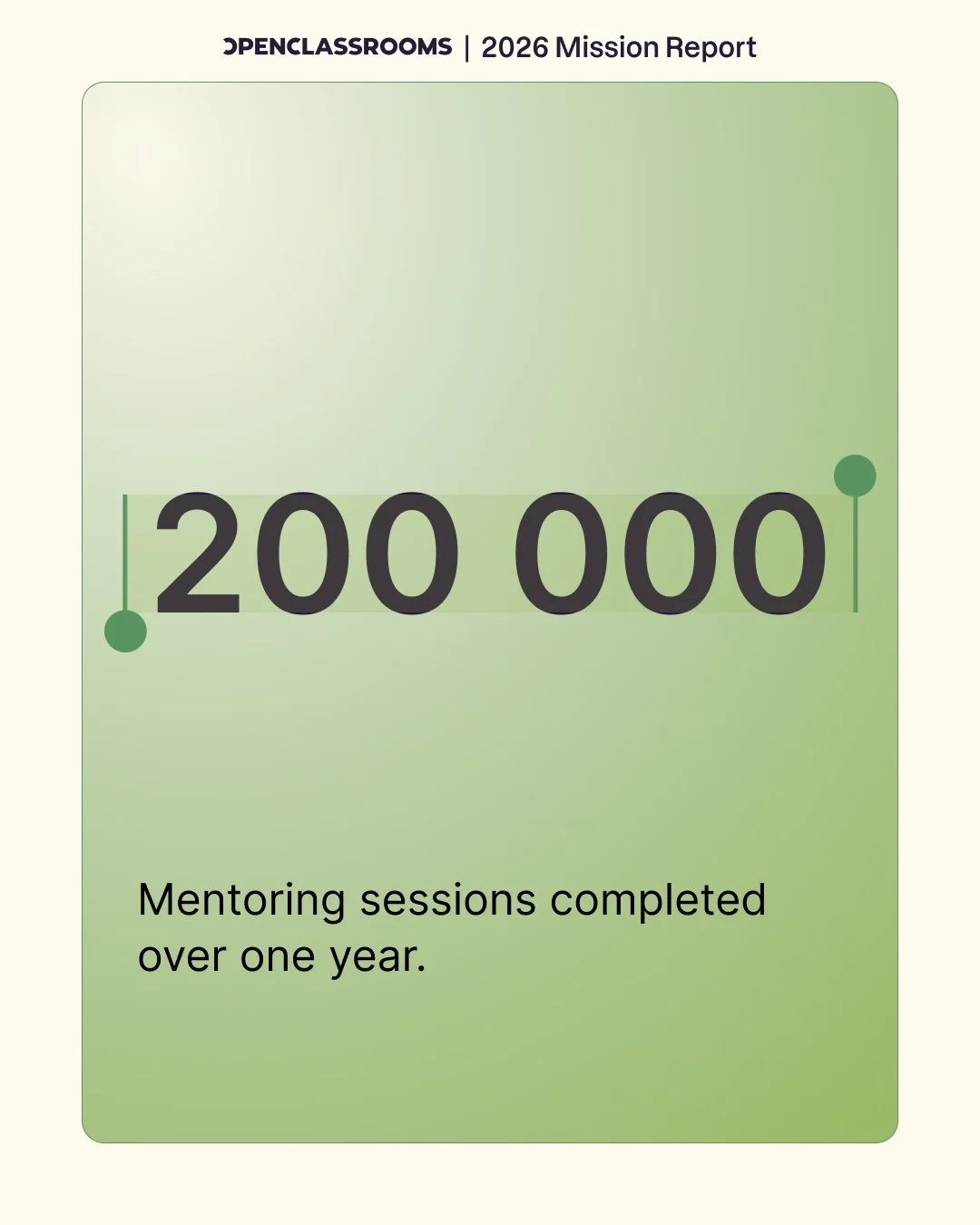
The deployment of adaptive mentoring sessions in 2025 adjusts session lengths to the student's needs. More than a quarter of these sessions now exceed 45 minutes to offer deep, dedicated support to those who need it most.
C - Diversity and inclusion in Tech
From admission and training to job placement, we ensure that every single one of our learners receives the best possible support. Whether they are people with disabilities, women in Tech, or job seekers, our priority remains identical: guaranteeing equal opportunities at every stage of the student journey.
D - Agile training, synchronized with global challenges
Our mission requires us to constantly listen to the transformations of the labor market and the needs of employers.
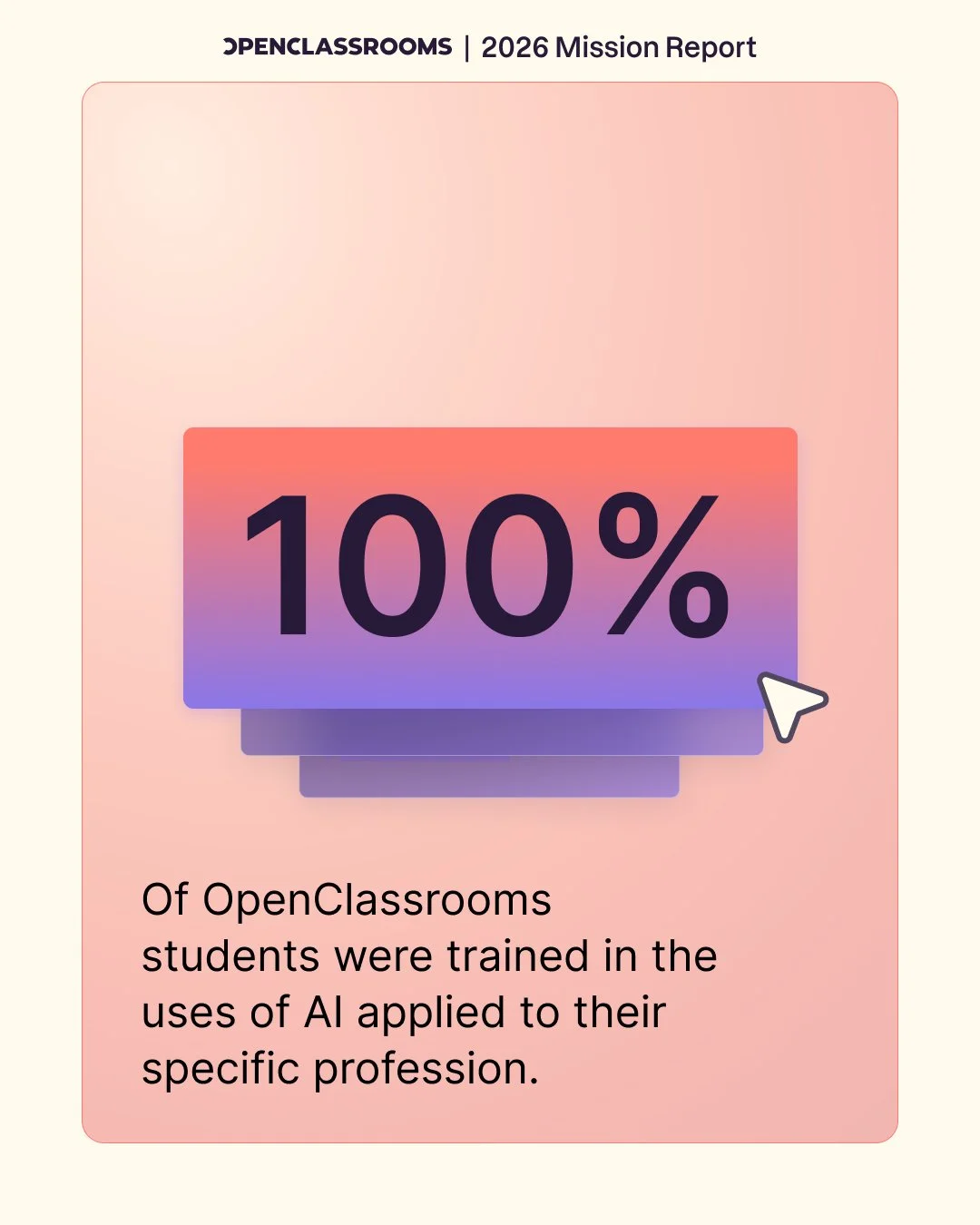
"AI-Ready" talent: 100% of OpenClassrooms students now integrate the practical use of generative AI into their programs, applied to real-world business scenarios. Additionally, 1 out of 2 students is already utilizing Companion, our AI tutoring assistant available 24/7.
Ecological and social transitions: In response to urgent economic shifts, new high-impact tracks were launched. In less than a year, 192 people enrolled in the Energy Renovation Project Manager track, and 769 people chose to train for professions in care, health, and early childhood education.
Mathieu Nebra, co-founder of OpenClassrooms, looks back at the role of AI in education.
“In France, job offers linked to AI increased by 252% between
2019 and 2024 (PwC, AI Jobs Barometer 2025). Worldwide,
the World Economic Forum predicts the creation of 78 million
jobs by 2030. AI is certainly shaking up the jobs market, but
rather than destroying it, it’s reconfiguring it.”
E - The apprenticeship model in the United States
In 2025, OpenClassrooms crossed a major threshold by securing accreditation from the WASC Senior College and University Commission (WSCUC), becoming the first American university focused on apprenticeship programs.
In a country staggering under the weight of USD 1,693 billion in student debt, this model allows apprentices to study while being paid by their employer, paving the way for a debt-free university degree.
Our Mission, seen from the Inside
Behind every number in this report are the dedicated individuals who take an exacting look at our impact.
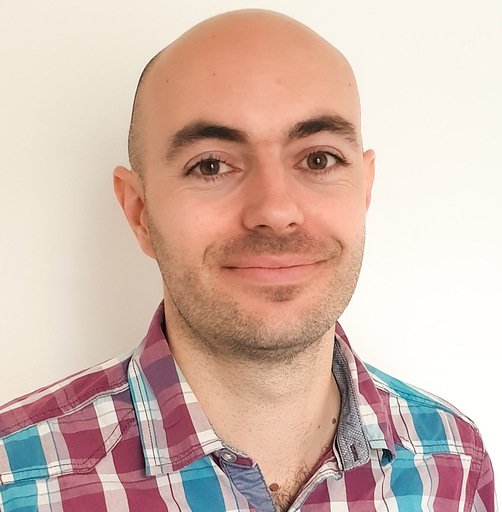
Sylvain Ghirardotto, Orientation and Admissions Team Manager
As a member of the Mission Committee representing our employees, Sylvain ensures we maintain our direction. On the ground, his team handles the welcoming and guidance of applicants.

Lauranne Bardin, Training Success Team Director
Lauranne and her teams (Mentoring, Student Success, Jury, Support) act as the guardians of each student's journey, from enrollment right through to graduation. Thanks to our flexible, human-centric model, 49% of students (from the 2023 cohorts) successfully complete their full graduation path.
Heading toward 2026: evaluating impact on the recruiter side
The Mission Committee, proud to bring together diverse profiles (such as co-founder Mathieu Nebra, and Anne Lebel, CHRO of Capgemini Group)—has established future priorities.
“In a world of rapidly-reconfiguring skills, what employers now want is not so much a specific career path as demonstrable skills. Talented candidates who are able to show what they are capable of, not only what they have studied or learnt. Skills-based recruitment is no longer a trend, but rather the norm for the coming decades.”
For 2026, the key recommendation from the committee chaired by Jean-Philippe Courtois is to build a brand-new metric to evaluate the impact of our training programs on employers. In 2025, the committee conducted surveys showing that a company’s ROI becomes tangible as soon as a hire reaches "Level 3: Autonomy" (the point where an employee resolves common problems independently and knows how to look for information). A new mathematical indicator is currently being designed to measure this value creation objectively.
Conclusion: a commitment that drives us
This mission report is not a finish line, but a stepping stone. It bears witness to the path traveled since 1999, the year Pierre Dubuc and Mathieu Nebra created Site du Zéro, which has grown today into an international, mission-driven university. This commitment is what drives us every single day.
Explore Further
Does our mission inspire you? Read the mission report in its entirety.
